New Construction vs Resale in Lehigh Acres: Which Makes More Sense in 2026?
Two houses, same street, same price — one built in 1990, one built last month. In Lehigh Acres the sticker price hides insurance, the roof, and what's buried in the backyard.
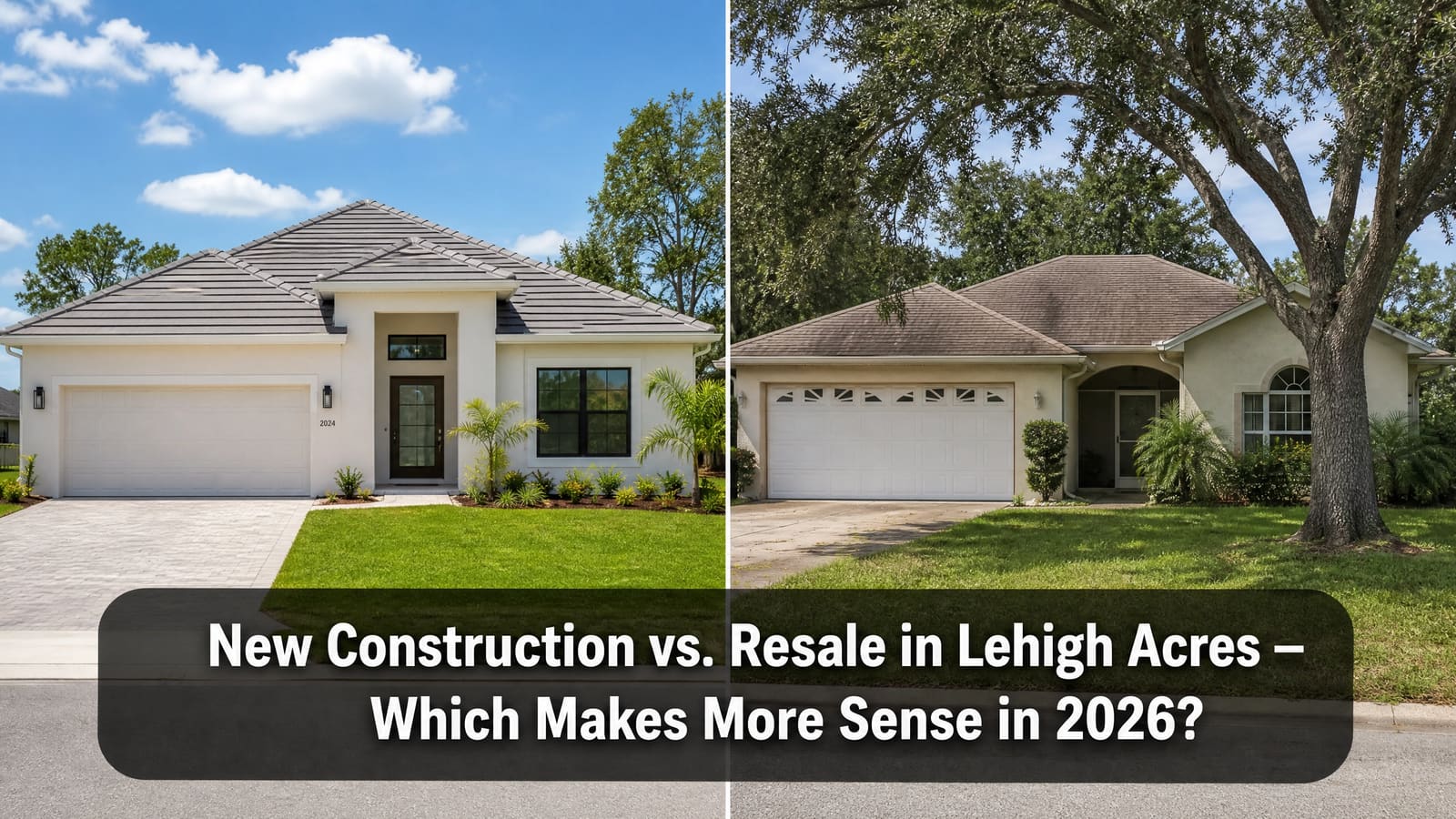
Picture two houses on the same Lehigh Acres street. Same three bedrooms, same two-car garage, same asking price to the dollar. One was built in 1990. The other came out of the ground last month. Which one's the smarter buy?
Most out-of-state buyers guess the resale — it's got the mature oaks out front, the bigger established lot, and older usually means cheaper, right? But in Lehigh Acres in 2026, that instinct can cost you real money every month you own the place — and here, it can cost you in a way it doesn't even cost you in the Cape. Because the sticker price is the one number that tells you the least about what a home actually costs out here.
So let's do the honest math — new construction versus resale — the way somebody who sells both would actually break it down. As of July 8, 2026, Lehigh Acres has 1,005 active new-construction listings across the community — nearly double the Cape's count, at a median new-build price of $340K versus the Cape's $450K. Here's how they really stack up against the used ones.
The Sticker Price Is the Biggest Liar in the Room
Here's the trap. You pull up two listings, you compare the two big numbers at the top, and you think you've compared the homes. You haven't.
Lehigh is the most affordable new-construction market in Lee County — D.R. Horton starts here around $265K, and the community-wide median new build is $340K. A comparable resale can list below that, and that's the number that pulls out-of-state buyers toward the older home. Right now the median resale list price in Lehigh is $300K, across 669 active resale listings, versus that $340K on new builds. And over the last 120 days, the resales that actually closed did so at a median of $260K — so yes, on paper, used looks cheaper.
But price is what you pay once. Carrying cost is what you pay for the next 360 months. And in Southwest Florida, the gap between a new home's carrying cost and an old one's isn't a rounding error — it's the whole ballgame. In Lehigh, that gap has two names, and neither one shows up in a listing photo.
The Insurance Math Nobody Puts in the Listing
Let's talk about the first one: your insurance premium.
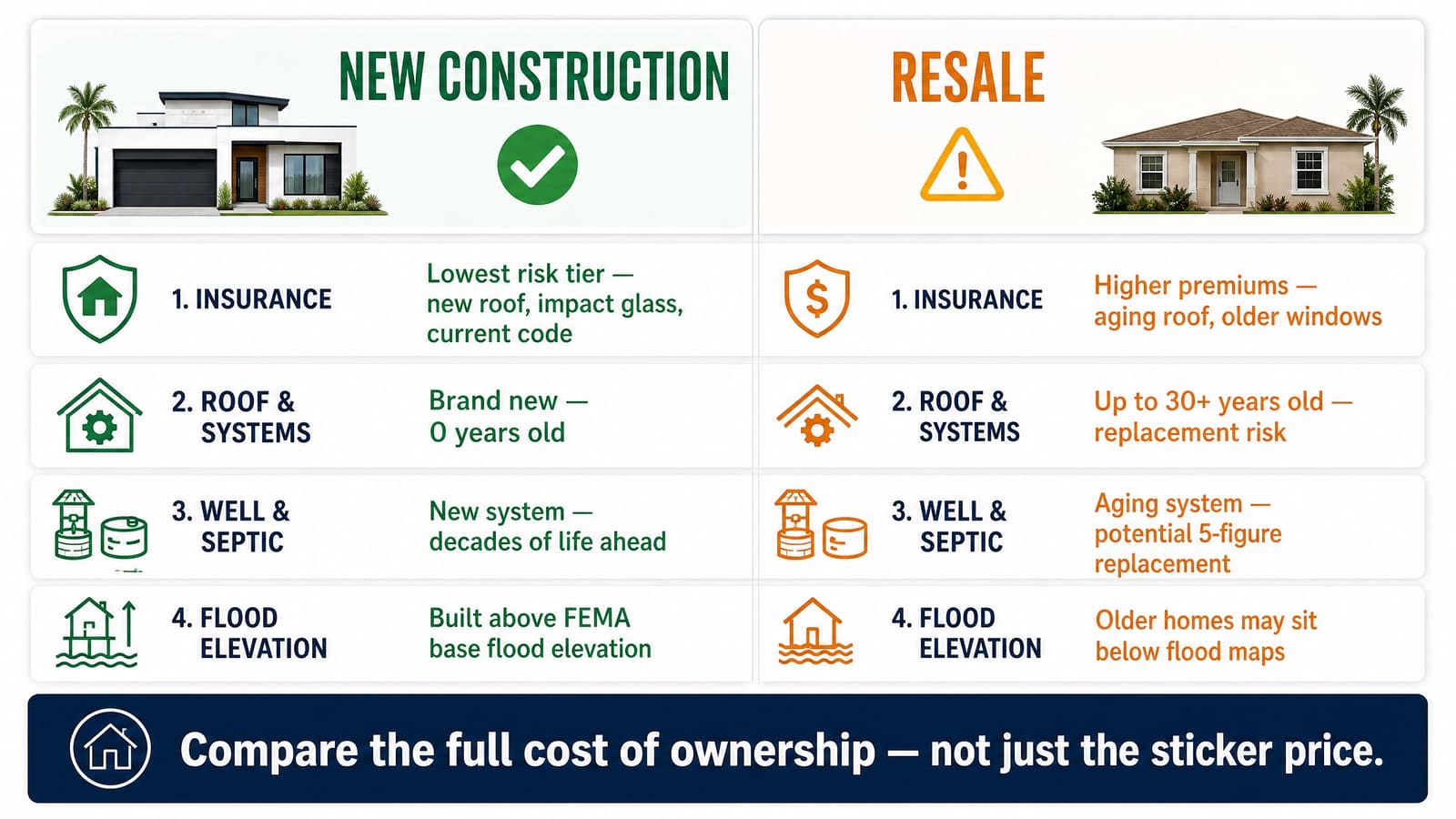
After the 2022 storm season and the property-insurance shakeout that followed, Florida carriers started pricing homes on one thing above almost everything else — the roof. A brand-new roof, new plumbing, new electrical, and new impact-rated windows and doors put a home in the cheapest risk bucket an insurer has. An older Lehigh resale with a 15-year-old roof and original single-pane windows? Different bucket. Sometimes a much more expensive one, and in the worst cases, a home a carrier won't write at all until the roof gets replaced.
That's the swing. It's routine down here for a new-construction home to insure for a fraction of what a 1990s resale on the same block costs to insure — every year, forever. New homes also come built to the current Florida Building Code: impact glass or shutters, hurricane strapping, elevated slabs. Older Lehigh homes can be retrofitted, but you're paying for that out of pocket, and a wind-mitigation credit on an old house still won't match a new one built to today's code from the slab up.
The Second Number: Well, Septic, and What's Under the Yard
Here's the Lehigh-specific one, and it's the thing that trips up buyers coming from a city.
Big stretches of Lehigh Acres are still on well and septic, not city water and sewer — it's one of the defining facts of this market. On a new-construction home, whatever the setup is, it's brand new: a new septic system and drainfield, or a fresh city hookup, with decades of life in front of it. On an older resale, that septic system and drainfield could be thirty years old and one bad inspection away from a five-figure replacement — and a tired well pump isn't cheap either.
That's a cost that lives entirely underground, never appears in a single listing photo, and out-of-state buyers almost never think to price. My advice: on any Lehigh resale, find out the age and type of the water and septic setup before you fall in love with the kitchen. On a new build, it's one less thing you're gambling on.
Built Above the Flood Line — the Old Homes Weren't
Here's a point that hits just as hard in Lehigh as it does in the Cape. Every new-construction home has to be built to today's flood rules — the finished floor sits at or above FEMA's base flood elevation for that lot, often with a foot of "freeboard" stacked on top. New homes are built up, out of the water's reach by design.
A lot of Lehigh's older housing stock isn't. Homes that went up decades ago were built under older, lower flood maps — or before the maps meant much at all — and they sit low, some noticeably below where a new home on the same lot would have to start today. When the water comes, elevation is everything: that low finished floor is why an older home takes on water and the new one down the road stays dry, and it's part of why the older one costs more to insure. You can replace a roof. You can't cheaply lift an old slab home out of the flood plain. Buy new, and the elevation comes baked in.
Here's the whole comparison on one card — the four costs that decide this market, side by side:
What Resale Actually Still Wins
Now let me not sell you mush — resale genuinely wins on some things, and I'm not going to pretend otherwise.
The lot and the trees. A lot of the newest construction sits on Lehigh's pre-platted scattered lots in the outer sections. The older, established parts of Lehigh handed those homes real mature oaks, settled landscaping, and often a bigger, fully-grown-in yard. If space and shade and a finished street on day one are the whole point for you, a lot of that is resale.
Being closer to the middle of things. The earliest-built parts of Lehigh are generally nearer the established commercial corridors and schools. Some of the newest inventory is further out. If a short drive to everything matters, resale skews toward the built-out core.
Speed of the market, honestly. Lehigh resales are moving — the actives are sitting at a median of just 66 days on market, and the ones that closed over the last 120 days went in a median of 44. If you're selling one to buy one, that liquidity is a genuine plus.
Price per square foot, sometimes. On a dry-lot, cosmetically dated resale, you can occasionally buy more house per dollar than new — if you go in clear-eyed about the roof, the insurance, and that septic system in the backyard.
That's a real list. Resale isn't the wrong answer — it's the right answer for a specific buyer who values a mature lot and central location over carrying cost and is willing to take on some risk to get there.
The 2026 Twist: The Builders Are Dealing
Here's what tilts the field this year. Lehigh new construction is a genuinely hot value market — 856 homes closed in the last 120 days at a full 100% of list price, so sellers aren't discounting these. But at a median 98 days on market and 4.7 months of supply, builders have inventory sitting — notice that's half again as long as the 66 days the typical resale sits — and inventory that sits makes builders generous.
That generosity shows up as rate buydowns, closing-cost credits, and price adjustments on standing spec homes — incentives a private resale seller almost never matches, because a resale seller can't reach into a mortgage company and knock two points off your rate. A national builder's in-house lender can, and right now, they will. When you're comparing a $340K new build to a $300K resale, run the builder's incentive against the resale's list price before you decide the resale is cheaper. Half the time the incentive erases the gap.
Listen Up: How to Actually Decide
Here's the honest framework, and it's simpler than the internet makes it.
Buy new construction if your priority is knowing your costs. New roof, new systems, brand-new well/septic or city hookup, current-code build, the lowest insurance bucket in the market, a builder warranty, and — in 2026 — a builder who'll buy your rate down. With Horton starting near $265K, Lehigh lets you get all of that at the lowest entry price in Lee County.
Buy resale if the lot and location are the whole point — a big mature parcel, a settled central neighborhood, a piece of Lehigh you can't get in new construction — and you've priced the roof, the insurance, the septic, and the flood elevation honestly, and the number still works.
What you should not do is compare two sticker prices, pick the lower one, and call it a decision. In Lehigh, that's how out-of-state buyers "save" $40K on the purchase and hand it right back in premiums, a roof, a new drainfield, and an old slab that sits too low. Run the whole cost of owning it, not just the cost of buying it.
💡 Key Takeaways
- In Lehigh Acres, the resale's lower sticker price ($300K median list vs $340K new-build median) is often erased by higher insurance, an aging roof, and an aging well/septic system — new construction frequently costs less to own.
- Insurance is the deciding factor: a new roof, impact glass, and current-code construction put a home in the cheapest risk bucket carriers have.
- The Lehigh twist is underground — much of the community is on well and septic. A new build's system is fresh; an old resale's could be one inspection from a five-figure replacement.
- New homes are built above FEMA's base flood elevation; older Lehigh homes sit lower under outdated flood maps — the difference between flooding and staying dry, and a driver of your premium.
- 2026 builders are offering rate buydowns and closing credits a resale seller can't match, with Horton starting near $265K. Run the incentive before you call resale cheaper.
Frequently Asked Questions
Is new construction more expensive than resale in Lehigh Acres?
On the sticker, often yes — the median new build in Lehigh is around $340K as of July 2026, though Horton starts near $265K, while the median resale lists at about $300K (and recent resales have closed at a median near $260K). But once you add insurance, roof age, the cost of updating an older home, and the age of the well and septic system, new construction frequently comes out cheaper to own on a monthly basis. Compare total cost of ownership, not just purchase price.
Why is insurance cheaper on new construction in Florida?
Florida insurers price heavily on roof age and construction standards. A new home has a brand-new roof, impact-rated windows and doors, and is built to the current Florida Building Code — which puts it in the lowest-risk, lowest-premium category. Older resale homes with aging roofs and original windows can cost significantly more to insure, and some carriers won't write them until the roof is replaced.
What should I check on a Lehigh Acres resale that I don't have to worry about on new construction?
The water and septic setup. Large parts of Lehigh Acres are still on well and septic rather than city water and sewer. On a resale, find out the age and type before you buy — an aging septic system, drainfield, or well pump can be a five-figure surprise. On a new-construction home, that system is brand new with decades of life ahead of it.
Are new homes in Lehigh Acres built higher out of the flood plain than older homes?
Yes. New construction has to meet today's flood requirements — the finished floor is built at or above FEMA's base flood elevation for the lot, often with added freeboard on top. Many older Lehigh homes were built decades ago under lower flood maps and sit noticeably lower. That elevation gap is a real difference in flood risk and a factor in your insurance premium, and it's not something you can cheaply change on an existing slab home.
Do builders in Lehigh Acres offer incentives that resale sellers don't?
They do. With a median 98 days on market and 4.7 months of supply, Lehigh builders are offering rate buydowns, closing-cost credits, and price adjustments on standing inventory. A builder's in-house lender can lower your interest rate in ways a private resale seller simply cannot, so always price the incentive into your comparison.
Should a first-time or out-of-state buyer choose new or resale in Lehigh Acres?
For most out-of-state and first-time buyers who want predictable costs and less risk, new construction is the safer starting point — new systems, a new roof, lower insurance, a fresh well/septic or city hookup, a warranty, and 2026 incentives, all at Lee County's lowest entry price. Choose resale when a specific lot or central location matters more to you than carrying cost, and you've priced the older home's true costs honestly.
See What's Actually Available
The market changes every week as homes list and close. See it live, filtered by what actually matters to you:
- Every active new build in Lehigh Acres
- New construction under $400K
- Compare every builder in one place
- All D.R. Horton listings (the affordable entry point)
Not sure whether a new build or a resale fits your budget, your timeline, and your tolerance for a roof and a septic project? That's the whole reason we're here.
If you need help buying in Lehigh Acres, call us at (239) 366-3996 and we'll run the real cost of owning both — sticker, insurance, septic, and all — so you're comparing homes, not just price tags.