
Water & Sewer vs Septic in Lehigh Acres New Construction: What Buyers Need to Know (2026)
No water bill — because the water comes from a well in your yard. In most of Lehigh, that's just how homes work. Here's what well-and-septic means for your money and your buying decision.
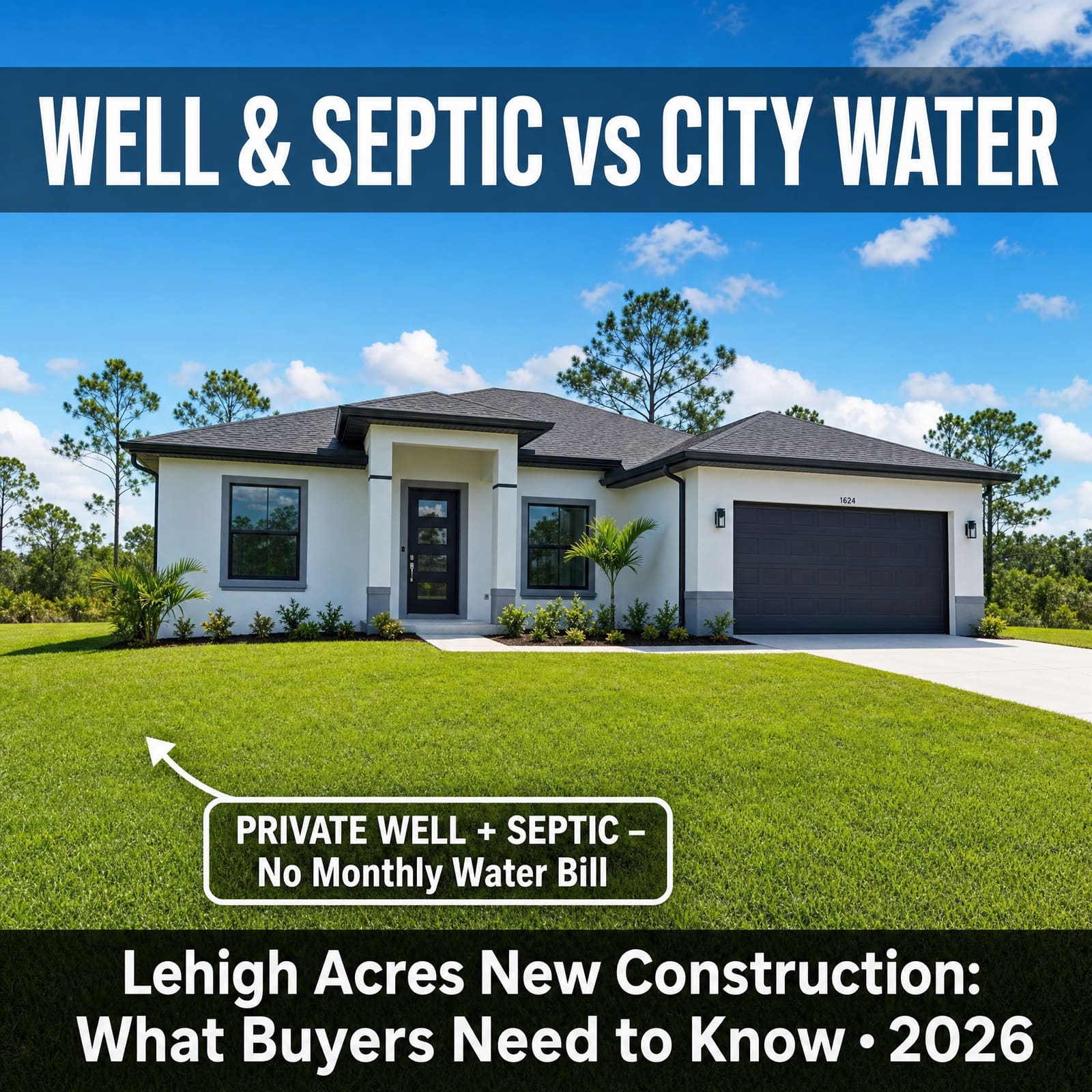
You close on a shiny new Lehigh Acres build. First month, you go looking for the water bill so you can set up autopay.
There isn't one.
No water bill, no sewer bill — because the water's coming out of a well the builder drilled in your yard, and the waste is going into a septic system buried out back. That's not a mistake and it's not a downgrade. In most of Lehigh Acres, it's simply how homes work. And if you're moving from a city where a pipe in the street handled all of that invisibly, it's the single biggest thing nobody warned you about.
So let's fix that. Here's what "well and septic" actually means for your money, your maintenance, and your buying decision — and how to tell the rare central-water lot from the well-and-septic norm before you write an offer.
In Lehigh, Septic Is the Rule — Not the Exception
Start with the fact that flips everybody's assumptions: Lehigh Acres is not a city. It's a giant unincorporated chunk of Lee County — roughly 130,000 people spread across a 1950s grid of quarter- and half-acre lots that were platted and sold long before anybody ran central utilities out here.
What does that mean underground? Central water and sewer in Lehigh is run by the FGUA — the Florida Governmental Utility Authority — and it reaches a minority of the community. FGUA serves on the order of 12,620 water customers and 10,420 sewer customers here. Now hold that up against 130,000 residents and tens of thousands of homes. The math is blunt: most of Lehigh Acres is on a private well and a private septic tank, and most new construction is too.
Flip that around from how Cape Coral works and it clicks. Over in the Cape, the city owns the pipes and is slowly converting everybody to them. In Lehigh, there's no citywide push — the default is your own well and your own septic, and central service is the exception you have to go looking for.
The Bill You Don't Get vs. the Maintenance You Own
Here's the trade, laid out honest.
The upside of well and septic is real and it shows up every month: no city water bill and no sewer bill. Your drinking water and your irrigation both come out of your own well — you're not metered, you're not billed for it. For a household that waters a big Lehigh lot, that alone is money most out-of-state buyers don't factor in.
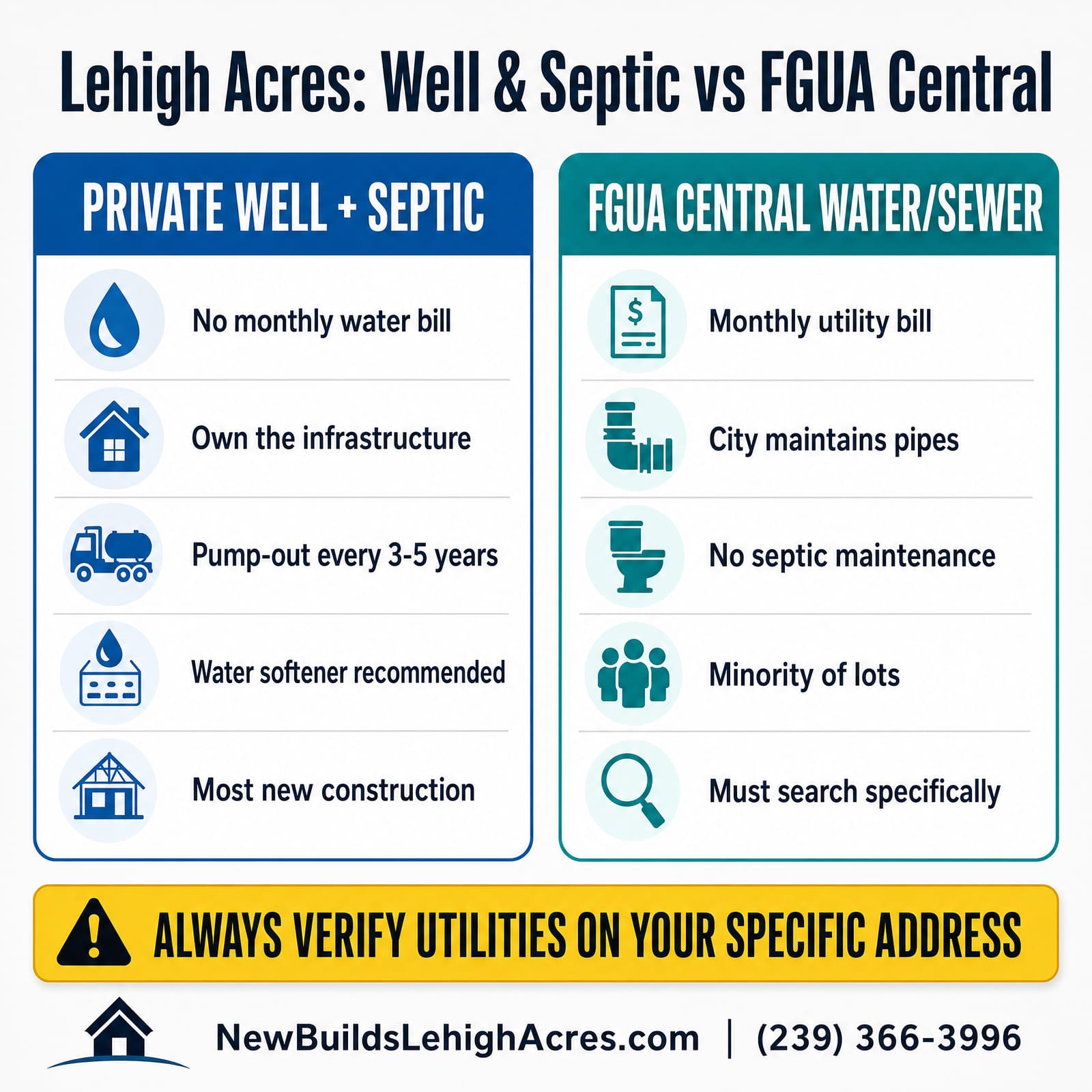
The catch is that you own the infrastructure, which means you maintain it. On a new build that's a light lift for years — everything's brand new — but you should walk in knowing the real rhythm:
| System | What you own | What it costs you over time |
|---|---|---|
| Private well | Pump, pressure tank, the well itself | No monthly bill; a pump eventually needs replacing; Lehigh water is hard, so most homes add a water softener |
| Septic tank & drainfield | Tank, drainfield on your lot | No sewer bill; pump-out roughly every 3–5 years; keep grease and "flushable" wipes out of it and it lasts |
| FGUA central (the minority of lots) | Nothing underground — you're a utility customer | Monthly water + sewer bill instead of self-maintenance |
Neither one is "better" in the abstract. A retiree who hates surprise maintenance might want the FGUA lot and the predictable monthly bill. A family watering an acre and allergic to utility bills might love the well. The mistake isn't picking one — it's not knowing which one you're buying.
Don't Bank on "Sewer's Coming Soon" — Because Mostly, It Isn't
Now the local reality that saves people from a bad assumption. Buyers hear "septic-to-sewer conversion" in the news and picture Lehigh going citywide like Cape Coral. It isn't.
The actual conversions here are tiny, targeted, and grant-funded. The headline project — FGUA's LEP-35 — covers roughly 290 to 300 homes along Lee Boulevard, in one census tract, and it exists because it's next to the Caloosahatchee and the state wanted to keep septic nitrogen out of the river. It's backed by about $7.5 million in state money, part of a larger $240 million statewide wastewater grant program born out of Florida's 2021 Clean Waterways Act. Converting those ~300 tanks is projected to keep roughly 4,500 pounds of nitrogen a year out of the Caloosahatchee basin.
Three hundred homes. Out of tens of thousands. That's the scale.
And here's the part that bites the people already living there: in that conversion zone, homeowners who delay hooking up lose the state funding and have to pay the connection cost themselves. As one FGUA project made the local news in 2025, retirees on fixed incomes were staring down a bill nobody could yet quote them. So for the tiny slice of Lehigh where sewer is coming, it's not free — and for the vast majority of Lehigh, it's simply not coming at all in any timeframe you should plan around. Buy the home for what it is today: almost certainly a well-and-septic home, and a perfectly good one.
One More Wrinkle: Even the Power Company Depends on Your Section
While we're on "it depends where the lot sits," Lehigh throws one more section-by-section curveball that catches out-of-state buyers: your electric provider isn't uniform either. Depending on which part of Lehigh your home is in, power comes from either LCEC — Lee County Electric Cooperative — or FPL — Florida Power & Light. Different companies, different rate structures, on the same map. It's the same lesson as the water: in Lehigh, the answer to "what utilities does this house have" is always check this specific address, never assume the city standard, because there is no city and there is no single standard.
Listen Up: How to Use This When You Shop
Here's how to turn all this into a smart buy instead of a first-month surprise.
Treat the utility question as a known before you tour, not a discovery after you close. On almost every Lehigh new build, the honest answer is going to be "private well, private septic, and here's your electric co-op" — and that's fine. What you want confirmed is that the well and septic are brand-new and properly permitted on that lot (they are, on legitimate new construction), and you want to budget realistically: plan on a softener for the hard water and a septic pump-out every few years, and you'll never think about it again.
If having a monthly-billed central connection genuinely matters to you — some buyers just prefer it — then say so up front, because those FGUA-served lots are the minority and you have to search for them specifically. Don't assume a listing has central water and sewer because it's new. In Lehigh, new says nothing about utilities. The address does.
And ignore anybody selling you on "sewer's coming, it'll boost your value." For 99% of Lehigh, that's not a plan you can bank on. Buy the house that works for you today — well, septic, softener, and no water bill — and you'll do just fine.
💡 Key Takeaways
- Lehigh Acres is unincorporated Lee County, not a city — most of its ~130,000 residents live on a private well and septic, and so does most new construction.
- Central water/sewer is run by the FGUA and reaches a minority of lots — roughly 12,620 water and 10,420 sewer customers across a community of tens of thousands of homes.
- Well and septic means no monthly water or sewer bill, but you own the maintenance: a softener for hard water, a septic pump-out every 3–5 years, and an eventual well-pump replacement.
- Septic-to-sewer conversion here is tiny and grant-funded, not citywide — FGUA's LEP-35 covers ~290–300 homes along Lee Boulevard, backed by ~$7.5M in state funding, to cut ~4,500 lbs of nitrogen a year from the Caloosahatchee. Don't assume sewer is "coming" to most of Lehigh — it isn't.
- Even the electric provider is section-based — LCEC or FPL depending on the address. In Lehigh, always verify utilities on the specific home.
- Confirm the well and septic are new and permitted, budget for light maintenance, and if you specifically want a central-utility lot, search for it on purpose.
Frequently Asked Questions
Does new construction in Lehigh Acres have city water and sewer?
Usually not. Lehigh Acres is unincorporated Lee County, and most homes — including most new construction — are on a private well and a private septic system installed on the lot. Central water and sewer, run by the FGUA, reaches only a minority of the community (roughly 12,620 water and 10,420 sewer customers). Always confirm the specific address, because "new" tells you nothing about the utilities here.
Is well and septic a problem for a new home in Lehigh Acres?
No. On legitimate new construction, the well and septic are brand-new and permitted to current standards. The upside is no monthly water or sewer bill. The trade-off is light maintenance you own: a water softener for Lehigh's hard water, a septic pump-out every 3–5 years, and eventually a well-pump replacement. Budget for those and it's a non-issue.
Is Lehigh Acres switching from septic to city sewer?
Only in very small, targeted areas. There's no citywide conversion like Cape Coral's. The main project, FGUA's LEP-35, covers roughly 290–300 homes along Lee Boulevard and is grant-funded to reduce nitrogen reaching the Caloosahatchee. For the vast majority of Lehigh, central sewer is not scheduled — so don't buy expecting a future hookup.
Will I have to pay to connect to sewer if it comes to my area?
In the small conversion zones, yes — and timing matters. In FGUA's Lehigh conversion area, homeowners who connect while state funding is available are covered, but those who delay can lose the funding and have to pay the connection cost themselves. Outside those specific grant areas, the question is moot because no conversion is planned. Always confirm your address's status before assuming anything.
Who provides water and electricity in Lehigh Acres?
Central water and sewer, where it exists, come from the FGUA — but most homes use a private well and septic instead. Electricity is split by section: depending on where the home sits, your provider is either LCEC (Lee County Electric Cooperative) or FPL (Florida Power & Light). Because it all varies by area, check the exact property rather than assuming.
How do I find out what a specific Lehigh Acres home has?
Ask the builder or your agent to confirm the address's water source (well or FGUA central), waste system (septic or central sewer), and electric provider (LCEC or FPL) in writing. We pull this for buyers all day and can tell you exactly what any Lehigh new build comes with before you tour or write an offer.
See What's Actually Available
The Lehigh market moves every week as homes list and close. Here's the fastest way to see what your budget buys — then let us confirm the utility setup on anything you like:
- Every active new build in Lehigh Acres
- New construction under $300K
- New construction under $350K
- Adams Homes new construction
Not sure whether a home is on a private well and septic or one of the rarer FGUA central-utility lots — or which electric co-op serves it? That's the whole reason we're here.
If you need help buying new construction in Lehigh Acres, call us at (239) 366-3996 and we'll tell you straight — well or central, septic or sewer, LCEC or FPL — before you sign anything.